Business Partnership Advisor
Together, we can fix your business and partnership problems

Chris Reich, Business Mediator
The Most Important Clause in Your Operating Agreement
Why don’t most Operating Agreements include a clause that clearly defines how a Partner may leave the Partnership voluntarily? Let’s talk about how to avoid a costly and tense disassociation of a Partner.
Why Does Defining a Partner’s Buyout in Advance Matter?
There are three major reasons to define how a buyout works in your partnership.
- If your Partner wants out and there is no defined process, Your Partner can hold the business hostage. They own equity and that comes with rights. If they demand a high price for their share of the business, you are forced to negotiate on their terms.
- If a Partner is not performing but will agree to leave the Partnership, you must meet their price or take it to court. Forcing a disassociation in court can cost each side $50,000 and can take 5 years to resolve.
- What if it’s YOU? What if you want to leave the Partnership? What if your Partner says your share is worthless?
Yes. This is important and should be addressed in every Operating/Partnership Agreement.
How Definitive Must the Exit Clause Be? VERY!
To be fair, many Operating Agreements have at least minimal language regarding a Partner’s voluntary exit from the Partnership. But, most of the time, those clauses are so vague they make the situation worse. For example, if the buyout clause says that a departing Partner must be paid “a fair market value” for their stake in the business, can you tell me how that is determined? Appraisal? Sure! How do we get people who are disputing to agree on the appraiser? And if one of them doesn’t like the appraisal?
Some agreements even say that if the departing Partner’s price is rejected, the other Partner must accept the offer and leave! How does that make sense??!
It’s important that we define the process, how we do this, and the value, how the buyout value is determined.
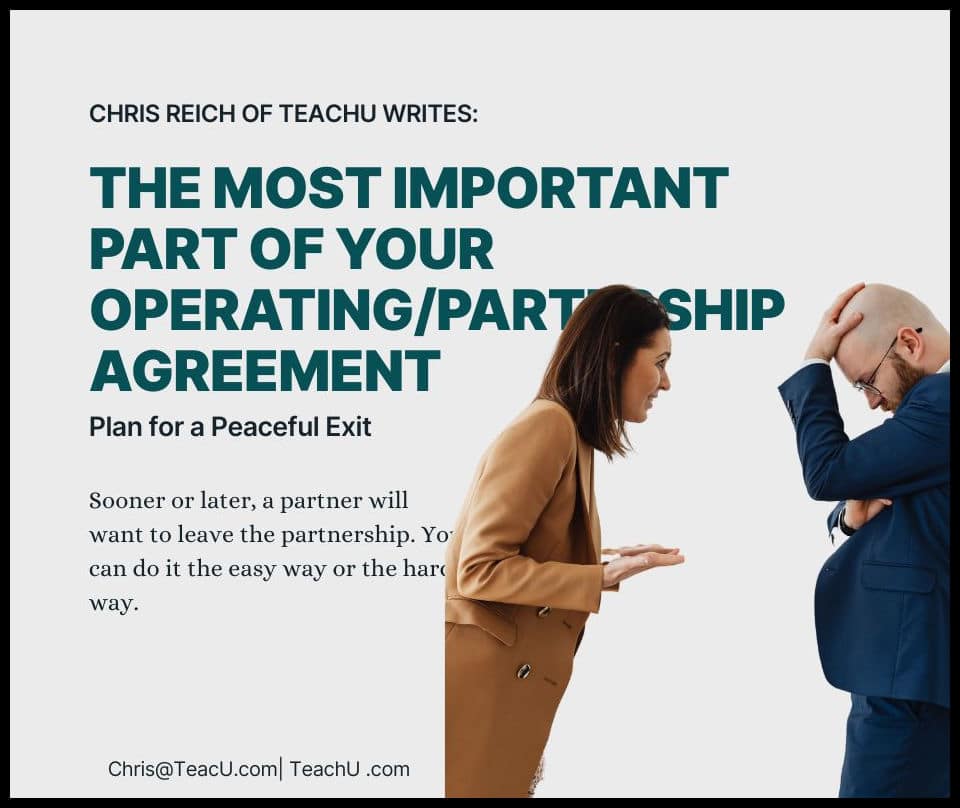
Sooner or later, someone will want to leave the Partnership. Your Operating Agreement should define how that happens.
Chris Reich, Business Partnership Mediator
What the Voluntary Exit Clause Should NOT Include
Let’s remember the goal of the Voluntary Exit clause. If a Partner wants to leave, we want to make that possible. After all, we can’t force a Partner to remain as a Partner. We also want to be careful that we don’t incentivize the wrong behavior. Meaning, if the business has a couple of hard months, we don’t want to make a buyout too attractive. There’s another important consideration. We don’t want to create a situation where we end up with a Partner we hadn’t planned on. If your Partner wants to leave the business, and you refuse his asking price, can he give his ownership to one of his kids? We always want to keep these two elements upfront in our planning:
- Don’t be so generous in your buyout provisions that you bankrupt the business if a buyout becomes necessary.
- Don’t have a clause that could open the business to a Partner you hadn’t planned on.
What the Voluntary Exit Clause SHOULD Include
We want to define the process of having a Partner withdraw from the business clearly. Start by thinking about a waiting period before a Partner can leave with a buyout. If the business is new, I normally recommend a 2 or 3 year wait before a Partner can take a buyout. Of course, a Partner can leave prior to the end of the restriction period, they just won’t be paid for their interest.
Why? That might seem harsh but remember, we don’t want to incentivize an exit. Don’t you agree that if someone is a Partner in a new business, they should commit to at least 2 years?
What happens after the restriction period?
Next question is whether notice is required. I don’t like long notice periods because once someone gives notice, their attitude tends to head out the door before their body. Regardless, the remaining Partner(s) may need to shift around some responsibilities or learn how to handle a particular function like billing. Certainly, some notice is appropriate. I think 30 days is about right, I’ve worked with Partnerships that insisted on 6 months.
Having a notice period means that notice has to be given. I generally draft this clause to say that if a Partner wishes to leave the Partnership, after the restriction period, that Partner needs to submit a request to disassociate under the terms of the Operating Agreement. The request needs to be submitted in writing to protect the remaining Partner(s) from a claim [later] that the departing Partner never intended to withdraw.
What About the Value of the Departing Partner’s Share
This is the most important piece. We have no idea when this clause might be invoked, if ever, and therefore, have no idea what the business will be worth at some unknown time in the future. We can set a value each year based on some calculation. I often recommend that approach. We create a form called a Statement of Agreed Value and record what the Partners think is a reasonable valuation. The Partners will need to update that value every year at their annual meeting. If they do not update it, the last agreed value stands until a new value is agreed upon.
Agree on a Calculation
The ideal way to plan for a future buyout is to agree on a formula to determine the value of the business. I won’t bore you with a bunch of calculations now, but the calculation would look like this:
- Add the value of the real assets of the business, That includes cash on hand, rough value of equipment and realestate, and any other real asset the business has.
- Then make a calculation that expresses the business’ ability to make money. This figure is usually a multiple of NET profit for a year.
Having a method like this defined in the Operating Agreement eliminates the battles that always ensue when buyout talks begin. Just have an agreed calculus to reach a valuation in advance.
Note: There are many ways to calculate the value of a business. I can help you with finding the best formula for your business.
Summary
To avoid future conflict, draft a clause that defines the process for a Partner to leave the Partnership voluntarily. That clause should inform both the process and the valuation to effectuate a Partner’s voluntary withdrawal from your Partnership. Agree on a formula to calculate the value should the time come for a Partner to leave.
Do this and when it’s time for someone to leave, it will be far less stressful.
Chris Reich, Business Partnership Mediation
“To be fair, many Operating Agreements have at least minimal language regarding a Partner’s voluntary exit from the Partnership. But, most of the time, those clauses are so vague they make the situation worse.”
Are You Ready to Clear Up Your Partnership Problems? Contact Me Now for a 100% Confidential Consultation.