Business Partnership Advisor
Together, we can fix your business and partnership problems
Video Summary of Post
Chris Reich, Business Partnership Mediation

What Makes a Contract Legal and Binding? Part 1
What Makes a Contract Legal and Binding?
Chris,
I need to draft some agreements with my business partner. Do we need a lawyer to draft them so they're 'official'? If we write them with help from you on the terms, would our agreements still be legal? In the past, my partner has made me promises but he never keeps them. This time I want it in writing! Will that make his promises legal?
Legal vs. Enforceable
We have a lot to cover in this post. Let's start by clarifying some terms.
Legal: This means your agreement, promise, or contract is not breaking any laws. For example, we cannot enter an agreement for me to pay you $200 to spray paint a message on your neighbor's garage door. Even though meet the terms of a contract, the specified act is not legal, thus the contract is void.
Binding: This means both parties intend to live up to the terms of the agreement. While this is almost certainly the intent of every agreement or contract, it is important to note that if the agreement is only meant to obligate one side of the deal, it can be invalidated. If you enter an agreement that only obligates one side, the contract may not be valid.
Promises: Promises are not contracts. A promise is a pledge to do or not do something. Let's say there is an elderly lady on your street. You promise to mow her lawn every week to help her out. July rolls around and you are taking your family on a two-week vacation. You let your neighbor know you won't be able to cut her grass for a couple of weeks. To your surprise she says, "We have an agreement. If you don't cut the grass or arrange to have the grass cut for me, I'll have someone do it and bill you for the cost." Can she do that?
Enforceable: An enforceable agreement or contract is one that can upheld in court. This is what people usually mean when they ask me is a contract is legal. They really are asking if a contract is enforceable. A contract, like the example I gave above in Promises, can be legal but not enforceable.
As you see, a contract can be legal yet not binding. And, the most important take away is that a promise, even if written up and signed, is not binding. If an agreement is not binding, it isn't enforceable. I assume you want your agreements between you and your partner(s) to be legal, binding, and enforceable. Let's look at the pieces that must be included to make a valid, binding contract.
The Six Essential Elements of an Enforceable Contract
To make your agreement binding (enforceable), you'll need to include these 6 parts. These 6 parts are so important that you'll want to be sure they are clearly stated and well-defined. For example, it won't do to say John agrees to repay Sam over the next 12 months with interest. You'll need to state the payment amounts, date due each month, and the interest rate.
#1 The Offer
This might seem obvious, but your contract must have an offer that is clear. We all understand that if I agreed to pay you "some money" for your car, you probably wouldn't agree. What if I offered to work for you until it's paid off? You might want work from me, but we still have not been specific about price and the amount of my labor that would satisfy the deal.
In addition to a clear definition of a price, we must also state that we both intend to be bound by the terms of the deal. An offer is not binding until there is acceptance and a bit more that I'll cover in a minute. If I see you drive up in a new Cadillac and I say, "I'd give you a million bucks to drive that car to my high school reunion!" Am I now bound to pay you a million dollars if you say, "Yes"? I'm not. I've made an obviously frivolous remark and we have not expressed an intent to make the offer binding. You might think offering a million dollars to use your carfor a day is so absurd the courts would never uphold our deal. Wrong. The courts do not evaluate the fairness of a ontract if the other, legal, elements are met. To make a valid offer, we must include:
- Must show intent to be bound
- Must be definite enough that a court can determine breach
- Ads and price quotes are usually not offers
By the way, an offer is is valid until withdrawn, expired, or rejected. If I offer you $400,000 for your house, and you say, "No," the offer is dead. If you come back to me in a week and say you changed your mind, too bad. The offer is dead.
#2 Acceptance
If the there is a valid offer, to make the contract valid the has to be acceptance. The acceptance portion of your contract should state (mirror) the offer. If I offer you $400,000 for your house, the acceptance clause should state that you agree to sell me your home for the amount of $400.000. [Note: I am greatly simplifying the deal. We should include a detailed description of the property and define all the terms of the deal.]
Summary of the acceptance requirement:
- Acceptance must mirror the offer
- Counteroffers reject the original offer
- Acceptance can be verbal, written, or by conduct
#3 Mutual Assent (“Meeting of the Minds”)
Mutual Assent has a deeper meaning than the Acceptance clause (above). This part isn't a clause, it's more of an intention. We can agree on everything, but I might draft the agreement in a way that is so complicated you can't even understand it. It might be legally following the principles above, but I might slip in a trick to get your house without actually paying you. "If the roof fails to pass inspection, the house becomes mine for a modest payment of $5." You would never agree to that, right? What if I included a line like this? To protect the seller, Si tectum inspectionem non superat, domus mea fit pro modica pecunia quinque dollariorum. If you ask me what that means, I'll say it's one of those weird legal things I had to put in to protect you. Don't worry about it.
What it translates to is what I said before about the roof! If it fails inspection, I get the house for $5! You signed the contract so you lose, right? No! I deliberately misled you. There was no "meeting of the minds and there was clear intent to deceive. The contract is invalid.
Summary of Element #3, Mutual Assent:
- Courts apply the objective theory of contracts:
- They look at outward words and actions, not secret intentions
- The question is whether a reasonable observer would believe the parties agreed
Proceed to Part 2
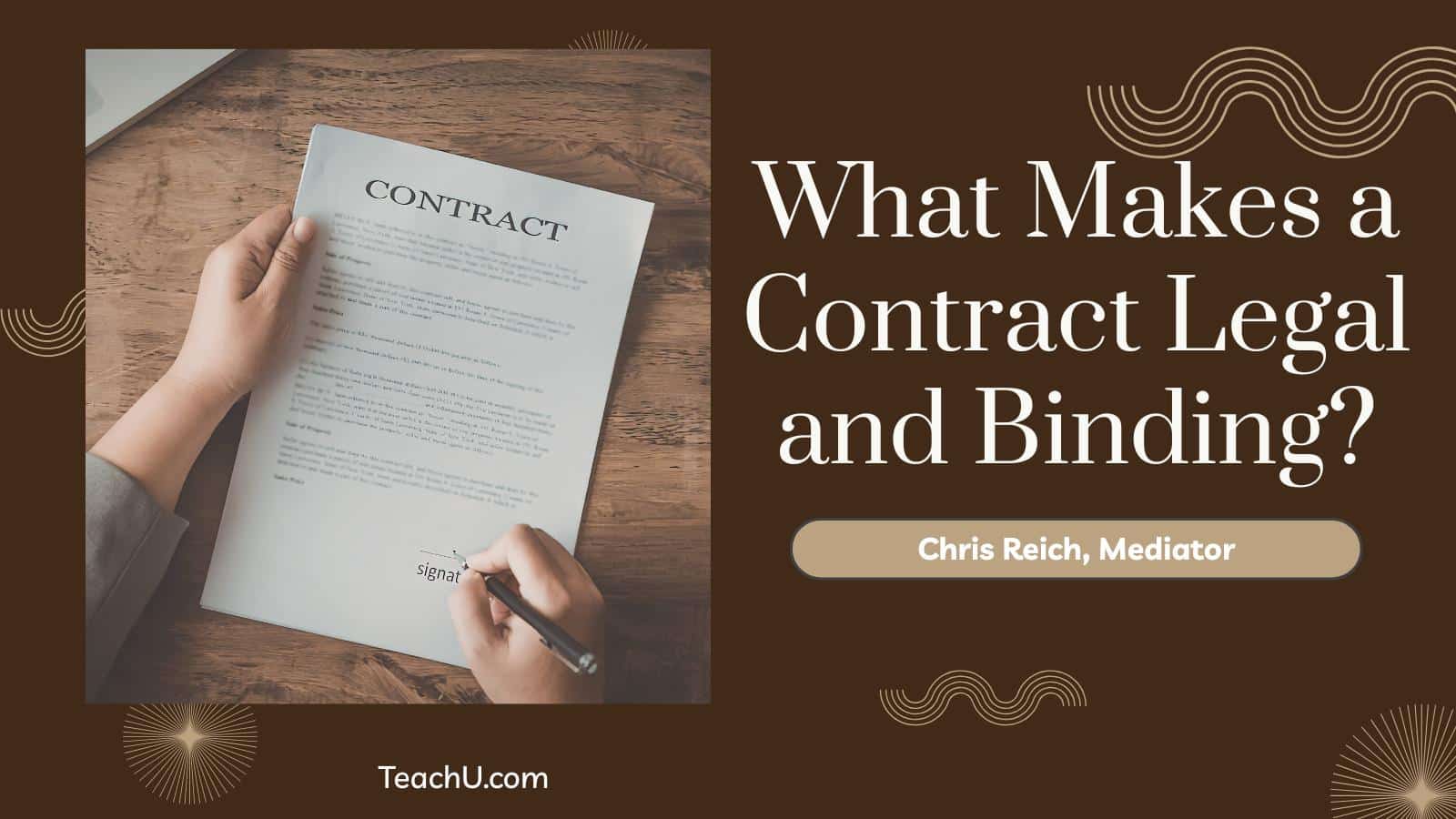
There are a few rules to follow if you want your agreements to be binding. Really, you want your contracts to be enforceable, right?
Chris Reich, Business Partnership Mediator
What Makes a Contract Legal and Binding? Part 2
#4 Consideration
No, we're not saying there is a legal requirement to be nice, though we always ought to be. In this context, the word is confusing as legal jargon often is! Consideration is what each party gets from the contract. In the instance of the house deal, the buyer's consideration is the house, the seller's consideration is the money for the house. Each side gets consideration in the deal. Don't forget what I said earlier, a deal doesn't have to be fair. The courts are not their to judge fairness, unlike what most people think. As long as there has been no deception or intent to deceive, the deal (contract) does not have to be fair.
We all can think of the example, often in family business, where dad sells the business to his only child for $1. Except for some tax consequences, the deal is legal, and both parties receive consideration.
Again, this seems like such an obvious requirement, how can it ever be missed? It can be tricky. Here's something to think about. I often have people over for dinner, my neighbor rarely entertains. Recently, he complained about people parking in front of his house. He threatened to sue me. I agreed to handle the problem. He wrote a contract saying that I agree to prevent my guests from parking in front of his house, on a public street, and in exchange, he agrees he will not sue me for past inconveniences to him. I want to keep peace in the neighborhood, so I sign the contract. Is it binding? Enforceable? Yes, my guests are legally parked, but if I agree and sign a contract, aren't I making a legal agreement?
No, I'm not. First, there is no "meeting of the minds". I'm not really agreeing with him, I'm signing because he is an annoying neighbor. You might even say that I signed under duress. The threat of him suing me induced me to sign. While he certainly would lose in court, dealing with a lawsuit is time-consuming and expensive. Even if I win, there is no guarantee I will recover expenses. But the bigger item here is that there is no exchange of consideration. Making him happy or preventing him from filing a frivolous lawsuit is not consideration for me. Thus, we have a promise from me to speak with my guests but that promise is not enforceable.
That was an easy one. What about this?
Jimmy is late for work every day. Usually he's only 5–10 minutes late, but sometimes he's as much as 20 minutes late. Jimmy's boss is very annoyed with Jimmy, but he's a good guy and not the punitive type. The boss draws up a contract that says if Jimmy is on time every day for the next 3 months, he will give Jimmy a 15% raise. Wow, that's a great incentive. Jimmy agrees and signs the contract. Jimmy is on time every day for the next 3 months. Jimmy says to his boss, "I kept my end of the deal and was never late for 3 whole months and because of this new habit, I'll never be late again. When will I see my raise?" The Boss replies, "I appreciate the effort you've put in to correct the problem, but I'm not giving you a raise." "But, aha," says Jimmy, "I have a signed contract!" Jimmy threatens to sue, but he has no case. Why?
In this case, Jimmy has no case because the boss is not getting consideration. But, wait! He's getting an employee showing up on time every day. What was a problem has been corrected. You might even say the boss is getting another 5-10 or even 20 more minutes a day of labor. Right? Wrong. The boss is merely getting what he was supposed to get in the first place. Jimmy is doing what the job requires, not something extra. If the only consideration is getting what ought to be had, there is no consideration.
There was a famous case a long time ago where a kid wasn't doing very well in school. The kid had a very wealthy uncle who said, "If you get your grades to a B average for the rest of high school, when you graduate, I'll buy you the new car of your choice up to $50,000 value." The kid worked his butt off and graduated with just short of a perfect A average. The uncle refused to buy him a car and asserted that it was for the kid's own good that he made the promise. The kid is way better off for having greatly improved his grades. The kid asserted that he did not do simply what was required (remember the example above?) but he went beyond the requirement to graduate and did considerable extra work solely to satisfy the requirements of his contract with his uncle. The kid still lost. The court ruled that the beneficiary of the extra work was the kid and that the uncle received no consideration as part of this arrangement. There have been many cases like this involving people who promise to pay for college if the child graduates with a certain GPA or gets into Harvard or some other target. Promises are not contracts. A similar unenforceable promise is the one about 'get good grades in college and I'll have a job waiting for you when you graduate'. Promises are generally not enforceable. Remember that.
Each party must exchange something of value — a “bargained‑for exchange.”
- Can be a promise, service, payment, or forbearance
- Courts do not weigh adequacy; even minimal consideration is sufficient
- Forbearance of a legal right is valid consideration
- Past consideration and moral obligations do not count
This can be muddy. If there is doubt, talk with a lawyer.
#5 Capacity
This is easy to understand but can be tricky in some cases. We all understand that we can't enter into a business contract with a child. Banks won't give a child a loan without the participation of a legal guardian. A child does not have the legal capacity to understand a contract so we don't let kids enter into contracts. What about older people? Can I enter a contract with my 95-year-old neighbor to buy his house for $100,000 and to pay off the remaining $75,000 of his mortgage and then rent it back to him for $1/month? We both get consideration: He is relieved from the payments, and he gets $100,000 cash. I get a house worth $850,000 for $150,000. Win-win right? Remember, the courts don't evaluate the fairness of the deal. I obviously am coming out way ahead.
We might have a problem if my neighbor's relative can demonstrate that my neighbor is operating with diminished capacity. Simply being elderly does not mean a person cannot enter or make contracts so long as they are of legal and mental capacity to do so. There are many sketchy schemes around designed to defraud people who are operating with diminished capacity.
What if you sign a perfectly good contract while under the influence of alcohol? If I have 5 or 6 beer after work, walk across the street to a car dealership and buy a new car. The salesman says, "you shouldn't drive, so we'll deliver the car to you in the morning." The dealer pays for an Uber to get me home. The next morning when the car shows up, I refuse delivery. The dealer says "a deal is a deal. We paid for a cab, we prepped the car for you, we had two people tied up to bring it to you (one drove the car, the other is driving the salesman back to the dealership). We're out quite a bit here. In fact, the contract says if you cancel the deal within 5 days, the dealership is entitled to a restocking fee of $1500." Am I out $1500? Not if I can prove the dealer knowingly entered a contract with me when I lacked the capacity to enter said contract. And, I may not have to prove that they knew. I only need to prove I lacked capacity at the time of signing.
Another important part of capacity is 'Free Will'. If a person is pressured or coerced into signing a contract, that contract can be invalidated. Shady payoffs often fall into this pit. If I know you were involved in some unseemly behavior and threaten to expose you unless I get $150,000 and you agree to pay me to keep silent, that can be invalidated because you are being pressured to sign under threat of exposure. This was common before attitudes about gay people evolved.
So capacity means legal ability such as age, mental capacity such as having full faculty, and free will as in not under pressure to sign.
I'm always cautious when mediating buyouts and one side starts making threats like, "accept my offer, or I'll just close the business down and start a new one under a different name without you." That certainly is excess pressure. Be careful.
Capacity in summary is:
Parties must have legal ability to contract.
- Adults of sound mind
- No coercion, undue influence, or severe intoxication
#6 Legality
The contract must not violate any laws. This is the simplest of all. We cannot expect a contract to be enforced by the courts if the function of the contract is unlawful. Duh! We can't do a big drug deal and expect the courts to enforce it. I don't think this one needs further elaboration.
The contract’s purpose must be lawful and not against public policy.
Summary
Whew! You made it! This might be my longest post. I hope you found it useful. The 6 principles that make a valid contract are very important for business people to understand, at least in general. Looking back at the question that led to this post, can you see why this partner's past agreements were not very useful? Can you see that you can make an agreement, but not a promise, with your business partner on the back of a napkin and have it be legal, binding, and enforceable? Do you need a lawyer? Not to make a contract 'legal".
The big thing with contracts is knowing WHAT to cover and how to make sure you meet the tests outlined here.
If you want help with a Partnership Agreement, I'm here to prevent problems in the future. All partnerships will experience tension. Get an agreement about how those tensions will be handled in advance!
Chris Reich, Partnership Mediator
"Promises are not contracts. A similar unenforceable promise is the one about 'get good grades in college and I'll have a job waiting for you when you graduate'. Promises are generally not enforceable. Remember that."
Are You Ready to End the Stress of Your Partnership Problems? Contact Me Now for a 100% Confidential Consultation.